

Start with flower shape, not color. Ask yourself: do petals radiate outward like a daisy, or fuse into a tube? That one question halves your search space instantly.
Next, check if leaves alternate or sit opposite each other—this narrows plant families fast.
Note the bloom month, measure the flower’s width, and pinch a leaf for scent.
Finally, cross-check your best guess against Go Botany or Missouri Plant Index. You’ll find there’s a logical system underneath that overwhelms you at first glance.
Start With Flower Shape: The Fastest ID Method
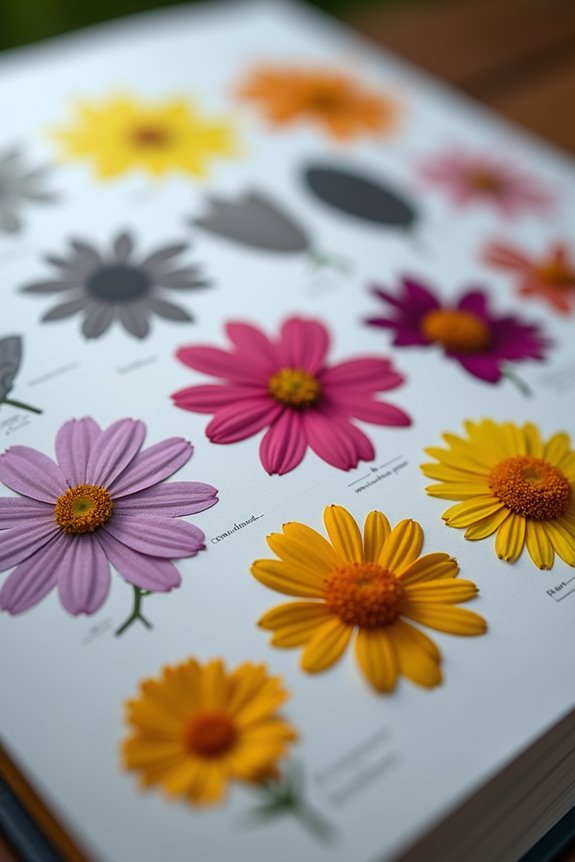
Why do we ignore a flower’s most obvious feature when we’re trying to figure out what it is?
Flower shape is your quickest pathway to identification—observe structure before considering color or bloom time.
I’ve realized that flower shape is your quickest pathway to identification using morphology. Before focusing on color or bloom time, I observe the structure itself.
Look for these patterns:
- Radiate vs. fused petals — Does the bloom have separate petals radiating outward like a daisy, or are they fused together like morning glory?
- Asymmetrical or irregular forms (think sweet pea)
- Numerous thin petals clustered densely
- Rays emerging from a central point
When measuring, I use the longest dimension for irregular flowers, or individual blossom size for clusters—not the entire grouping.
This morphology-first approach narrows possibilities instantly. You’re already narrowing down hundreds of options before considering anything else.
Five Flower Forms That Speed Up Your Search

Once you’ve decided to use flower shape as your starting point, narrowing things down to just five main categories makes the search way easier. You’ll encounter daisy-like flowers with rays spreading outward, irregular blooms that don’t follow a neat pattern, petals that fuse together along the edges, and flowers packed with so many tiny petals they’re almost impossible to count individually. Learning to spot these distinct forms—asymmetrical and irregular blooms, ray and petal patterns, and fused petals and clusters—cuts your identification work in half because you’re immediately ruling out entire groups of flowers.
Asymmetrical And Irregular Blooms
How do you spot a flower that doesn’t follow the rules? You’re looking at asymmetrical blooms—flowers that break the typical pattern of petals radiating from a center point. Unlike daisies with their orderly arrangement, irregular flowers demand a different approach to identification.
I’ve found these flower shape categories useful when searching:
- Everlasting peas lack classic petals radiating outward
- Petals don’t align symmetrically around a central disc
- Irregular shapes require examining individual petal placement
- No predictable pattern exists across the bloom
These asymmetrical blooms aren’t random—they’re just organized differently. Once you recognize this distinctive form, you’ll spot irregular flowers quickly. They’re easier to identify once you stop expecting symmetry, which improves your identification process.
Ray And Petal Patterns
Now that you’ve got asymmetrical blooms down, I’ll show you the flip side—flowers that actually do follow a pattern. Most flowering plant forms organize their petals in predictable ways, and once you recognize these rays or petals arrangements, identification becomes much easier.
I’ve found that spotting these patterns helps tremendously. Daisy-like flowers radiate petals outward from a central disc, creating that classic wheel shape you’ll recognize instantly. Other flowering plant forms display numerous thin petals, fused petals joined along edges, or standard symmetrical heads.
| Flower Type | Petal Arrangement | Examples |
|---|---|---|
| Daisy-like | Rays from center | Daisies, coneflowers |
| Thin petals | Many slender rays | Dandelions, thistles |
| Fused petals | Joined edges | Fieldbindweed, morning glories |
| Standard | Symmetrical head | Roses, tulips |
Understanding these patterns changes your searching strategy entirely.
Fused Petals And Clusters
Fused Petals And Clusters
When petals fuse together along their edges, they create a single continuous tube or funnel instead of separate pieces—and this trait speeds up identification work. I’ve found this characteristic cuts my search time significantly.
Why Fused Petals Matter
Fused petals—technically called corolla morphology—help you narrow plant families quickly. You can’t count individual petals like you would with separate ones, so you’re actually looking at the whole structure differently.
Key Identification Markers:
- Flower clusters displaying fused petals across multiple blossoms
- Morning glories and field bindweed show this pattern clearly
- The continuous corolla tube distinguishes these from radiating flowers
- Individual petals remain hidden within the main bloom
This morphology trait groups similar plants together, letting you skip entire families during identification. Once you recognize that fused-petal pattern, you’ve identified a distinct category of flowers.
Opposite vs. Alternate Leaves: Your Quickest Filter
once you spot the pattern, you’ve already eliminated half your options. I use the MAD-Cap-Horse mnemonic for common opposite-leaf plants, which helps me quickly recognize those families.
This single observation becomes your primary filter in any leaf arrangement identification key. You’re not overthinking it—you’re working more efficiently.
Spot Plant Families by Their Signature Traits
I’ve found that once you recognize a plant family, you’re holding a practical tool for identification—because plants in the same family share evolutionary traits like leaf shape, margin patterns, and arrangement. When I spot serrated (jagged) leaf edges, for instance, I’m already thinking Rosaceae, which includes cherries and strawberries, and I can narrow my search significantly rather than treating each feature in isolation. Your leaf arrangement (opposite versus alternate) combined with distinctive shapes like cordate (heart-shaped) or sagittate (arrow-shaped) leaves creates a filtering system that gets you to the right family faster than guessing.
Morphology Reveals Family Patterns
Most plant families share recognizable signature traits that you can spot once you know what to look for. Studying morphology—the plant’s physical structure—provides a practical advantage in identification. You’re learning a visual language that families communicate through their leaves, flowers, and growth patterns.
Here’s what to focus on when examining specimens:
- Leaf arrangement (opposite versus alternate positioning along stems)
- Leaf margins (smooth, serrated, or lobed edges that indicate family identity)
- Leaf shape (cordate, hastate, or sagittate forms revealing evolutionary relationships)
- Flower structure (petal counts and stamen patterns linking species together)
Once you recognize these morphological cues, plant families become predictable. Your identification guide shifts from overwhelming reference material to an intuitive tool.
Shared Traits Within Families
Key Family Markers:
- Leaf arrangement: opposite or alternate placement
- Flower structure: petal count and symmetry patterns
- Fruit type: how seeds develop and disperse
The Rosaceae family, for instance, typically shows five petals with a cup-shaped base called a hypanthium. Lamiaceae plants almost always have square stems and aromatic leaves when crushed. Fabaceae flowers resemble tiny peas with their distinctive shape.
Leaf Arrangement And Shape Clues
Have you ever noticed how leaves don’t just scatter randomly along a stem? They’re actually organized in patterns that reveal which plant family you’re looking at.
Understanding leaf arrangement helps you narrow down possibilities fast:
- Opposite arrangement: Leaves emerge in pairs at each node (think Maples and Dogwoods)
- Alternate arrangement: Leaves stagger along the stem in a zigzag pattern (like Oaks)
- Leaf shapes: Cordate (heart-shaped), hastate (spear with notches), and sagittate (arrowhead) each hint at specific families
- Margins matter: Serrate (saw-toothed) and lobed edges provide additional clues
When you combine leaf arrangement with leaf shape and margins, you’ve got a powerful tool. Using dichotomous keys becomes easier when you spot these signature traits first. Checking arrangement before diving into detailed identification saves time in the field.
One Dichotomous Question That Cuts Your Search in Half

When you’re standing in front of an unfamiliar flower, how do you narrow down what you’re looking at without getting lost in hundreds of possibilities?
I’ve found that asking one strategic question simplifies flower identification. Using a dichotomous key—a decision tree where you choose between two options—works best when your first question targets major differences.
Ask yourself: Are the petals arranged in radial symmetry (actinomorphic) or bilateral symmetry (zygomorphic)?
Radial flowers look the same from every angle, like daisies. Bilateral flowers have distinct top and bottom halves, like snapdragons. This single split separates massive plant taxonomy groups immediately, cutting your search space roughly in half and setting you up for precise follow-up questions.
Cluster Types: Individual, Spike, or Flat-Topped
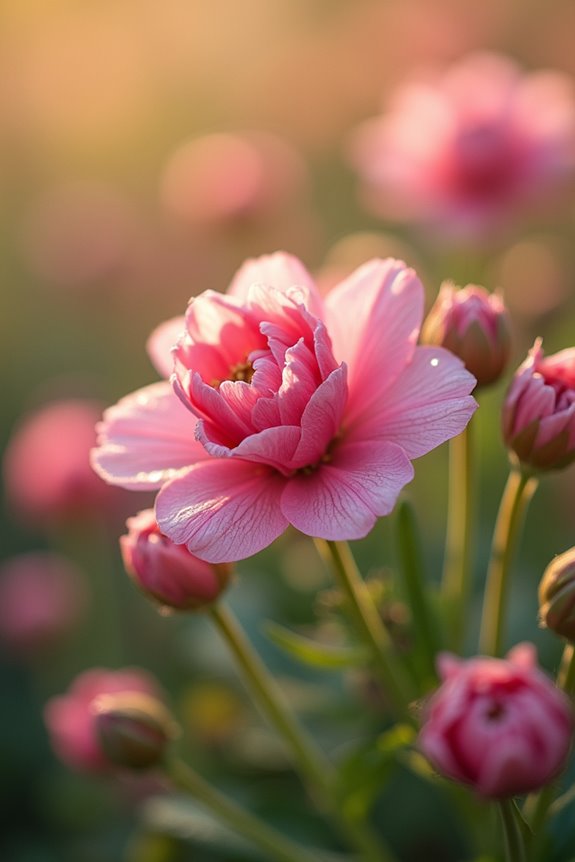
I’ve found that spotting how flowers arrange themselves on a plant is one of the quickest ways to narrow down what you’re looking at. You’ll run into three main patterns: flowers standing solo, flowers lined up along a central stem like beads on a string, or flowers clustered flat across the top like a canopy. Once you learn to spot these differences, you’ll move through your plant ID much faster than trying to memorize every species out there.
Individual Flowers Explained
The way flowers arrange themselves on a plant tells us a lot about what we’re looking at. When I spot a solitary blossom, I’m seeing a flower that stands alone on its stem—not crowded with others. This matters because flower structure helps us ID plants faster.
Solitary blooms pop up separately, making them easier to study. I’ve noticed these independent flowers share common traits:
- Single stem connection with no clustering
- Direct attachment to the main plant stem
- Clear visibility of all flower parts
- Easier petal and stamen observation
Think roses or tulips—they’re classic examples of inflorescence types featuring individual blooms. Understanding solitary blossoms versus clustered arrangements sets a solid foundation for recognizing plant families and genera. It’s one of the quickest ways to narrow down what you’re looking at.
Spike And Elongate Clusters
Look for that characteristic stretched-out appearance rather than a compact head. Individual blooms might blur together into one continuous line, or you’ll spot them distinctly spaced. Once you train your eye to spot this arrangement, you’ll recognize these patterns everywhere.
Flat-Topped Rounded Arrangements
These arrangements share distinct characteristics:
- Multiple small flowers radiate from a central point, creating an umbrella-like cluster
- Individual blooms sit at nearly identical heights, forming a level surface
- The umbrella-like cluster spreads horizontally rather than vertically
- Several flowers collectively build a broad, even top instead of a visible spike
When examining flowering plant identification, pay attention to that uniform height across the flower-bearing top. Unlike elongated spikes, flat-topped clusters give you a clear, horizontal silhouette. You’re essentially looking for a level platform rather than a tower structure.
Size and Bloom Month: Confirm Your Best Guess
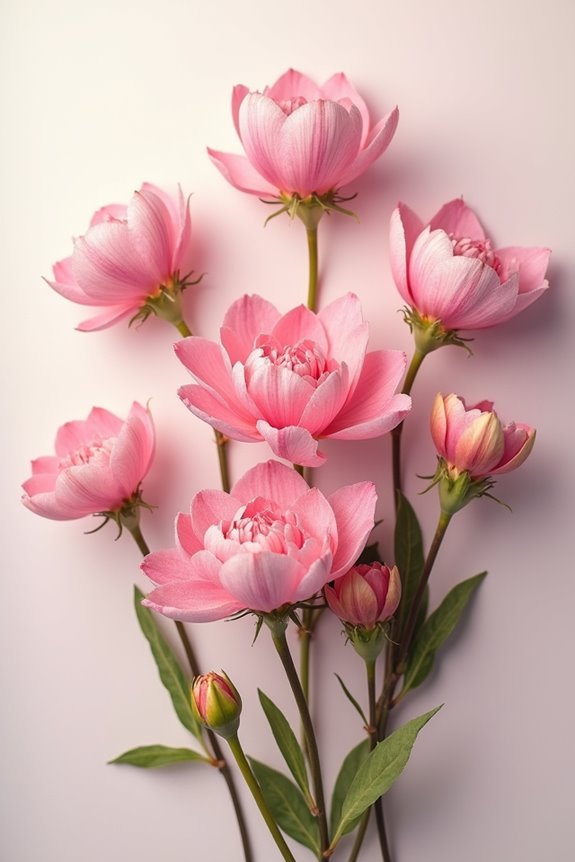
Bloom month timing seals the deal. I cross-reference when flowers typically appear in the northeastern US, accounting for regional weather differences. Your discovery blooms in July? Rule out spring-only varieties. These two details—flowering plant identification through size and timing—transform your best guess into certainty. You’re not just hoping anymore; you’re confirming.
The Smell-and-Touch Test Before You Use Apps

Once you’ve narrowed things down with size and bloom timing, your senses become your next tool—before you even open an app. I’ve found that the smell-and-touch test gives me reliable clues about plant morphology without damaging anything.
Here’s what I check during field identification:
- Scent: Crushed leaves releasing minty aromas often signal Lamiaceae (mint family)
- Stem shape: Running your thumb along the stem—square stems confirm mint family possibilities
- Leaf arrangement: Gently probing reveals opposite versus alternate patterns
- Texture: Hairy petals or waxy surfaces differentiate similar-looking species
These tactile observations narrow my guesses considerably. Then I confirm findings with apps or field guides, avoiding misidentification. Your hands and nose are practical identification tools.
Double-Check Your Answer in Go Botany or the Missouri Plant Index
How confident are you in your field identification? I’ve found that my initial guesses aren’t always right, so I verify using two solid resources.
Go Botany offers picture-assisted entries where I can cross-check my plant identification against their database. I follow their key answers to ensure consistency with what I observed—leaf arrangement, petal structure, the whole picture.
Missouri Plant Index provides links by both common and Latin names. This helps me confirm whether I’m looking at the right species.
Here’s my verification process:
- Match leaf arrangement (opposite versus alternate)
- Compare petal patterns
- Check both resources side-by-side
- Note any conflicting information
This double-checking approach catches my mistakes before I share incorrect identifications with fellow plant enthusiasts.
Your Quick Flower ID Checklist
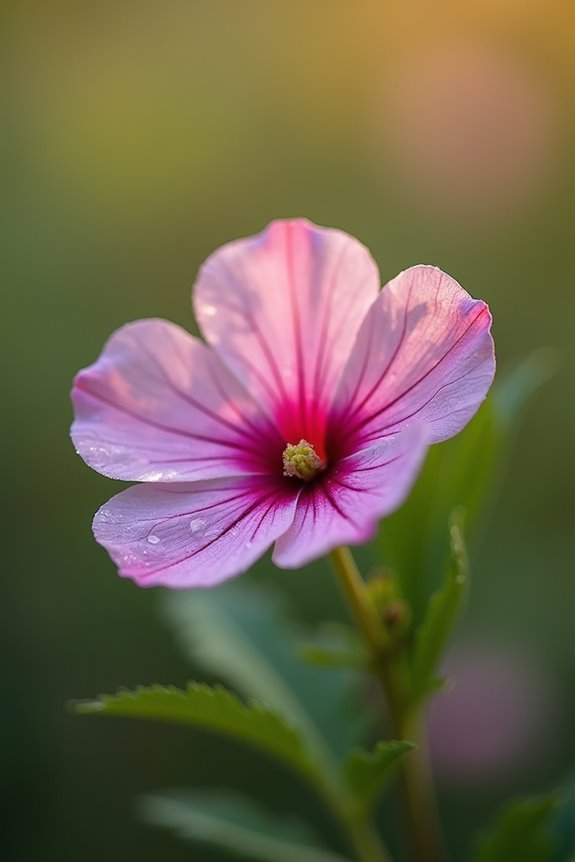
Once you’ve narrowed down your plant using those verification resources, you’ll want a streamlined system for cataloging what you’re actually seeing in the field—and that’s where a quick checklist comes in handy. This identification tool keeps you organized when you’re surrounded by flowers.
A streamlined checklist transforms chaotic field observations into organized, reliable plant identification data.
I’ve found that focusing on these essentials prevents me from getting overwhelmed:
- Flower shapes: Asymmetrical, ray-like, thin petals, or fused varieties
- Measurements: Plant height in feet, blossom diameter, or longest dimension for irregular forms
- Color and timing: Note the hue and bloom month specific to your region
- Supporting details: Leaves, photos, and cluster type (individual, elongated, or rounded)
Your field guide becomes useful when you’re disciplined about documenting these specifics. This approach turns casual observations into reliable identification data.