
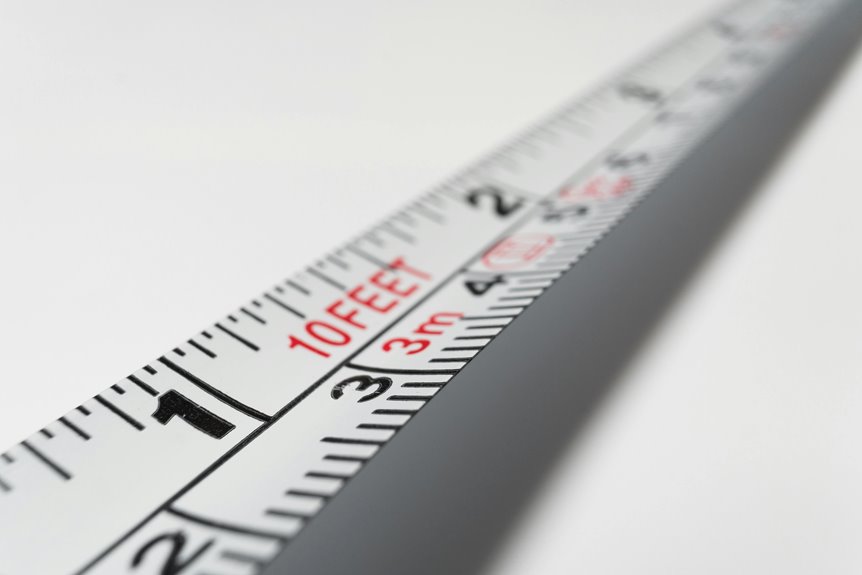
To convert yards to meters, multiply by 0.9144—that’s the exact factor you’ll need. So 10 yards becomes 9.144 meters, not 10. This matters when you’re ordering materials internationally or reading building specs. The confusion happens because meters are longer than yards (1 meter ≈ 1.09 yards).
For fractional yards, convert to inches first, then multiply by 0.0254. Stick with four decimal places for accuracy, and you’ll avoid costly mistakes. The details below show you exactly how.
The Conversion Formula: Multiply Yards by 0.9144
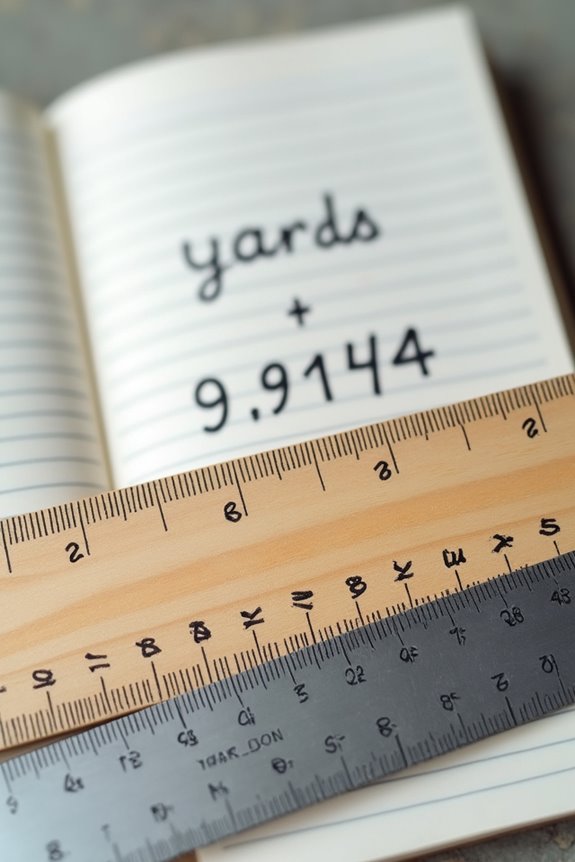
The Basic Formula
Meters = yards × 0.9144
That 0.9144 factor is the exact conversion rate. One yard equals 0.9144 meters, so you multiply whatever yardage you have by this number.
Quick Examples
Here’s how this works in practice:
- 4 yards × 0.9144 = 3.6576 meters
- 10 yards × 0.9144 = 9.144 meters
Reference Points
Key benchmarks to remember:
- 10 yd = 9.144 m
- 100 yd = 91.44 m
Once you use this formula a few times, it becomes automatic. You’ll convert yards to meters with ease.
When Yards-to-Meters Matters: Regional Differences
I’ve noticed that whether you’re converting yards to meters really depends on where you live and what you’re doing—the United States still uses yards for construction, sports, and everyday measurements, while most of the rest of the world switched to the metric system long ago. You’ll find yourself reaching for that 0.9144 conversion factor whenever you’re reading international building specs, comparing fabric lengths from overseas suppliers, or trying to understand a soccer field’s dimensions (which are given in meters everywhere except here). Understanding both systems isn’t just helpful; it’s necessary if you’re working on projects that cross borders or involve any kind of global communication.
Imperial System Dominance
Why do you need to know about yards-to-meters conversions? I’ll tell you—you’re probably living or working in a place where the Imperial system still holds strong. In the US, UK, and Canada, we’re stubborn about our yards. Sports fields, construction projects, and real estate listings all use yards, not meters.
Here’s the thing: yards to meters conversions matter because we’re caught between two worlds. You’ll encounter yards in:
- American football fields (100 yards)
- Construction blueprints
- Athletic competitions
- Property measurements
Meanwhile, the rest of the world? They’re metric. That’s why understanding 1 yard equals 0.9144 meters keeps you relevant. You’re not switching systems—you’re translating between them. Multiply yards by 0.9144, and you’ve got meters. Simple.
Metric Adoption Worldwide
How often do you stop to think about which measurement system dominates where you live?
The metric system shapes our world more than we notice. Most countries use meters for science, construction, and everyday life—it’s the global standard. Meanwhile, yards still hold strong in the U.S., U.K., and Canada for specific tasks like sports fields and construction projects.
This split matters when you’re converting measurements. The exact conversion—1 yard = 0.9144 meters—stays consistent everywhere. Whether you’re calculating 10 yards (9.144 meters) or 100 yards (91.44 meters), precision doesn’t change.
Understanding both systems helps us communicate clearly. International trade, engineering projects, and scientific work all depend on accurate conversions between yards and meters, bridging regional differences smoothly.
Quick Reference: 1 Yard Equals 0.9144 Meters
The conversion from yards to meters isn’t complicated once you’ve got the magic number locked in: 1 yard = 0.9144 meters.
I find this conversion straightforward when I remember the multiplier. You’re basically shrinking the distance slightly since meters are smaller units. Here’s what I do:
To convert any yard measurement:
To convert any yard measurement, simply multiply your yard number by 0.9144.
– Multiply your yard number by 0.9144
Practical examples:
- 4 yards × 0.9144 = 3.6576 meters
- 10 yards × 0.9144 = 9.144 meters
- 100 yards × 0.9144 = 91.44 meters
I’ve noticed these quick benchmarks stick with me: 10 yd = 9.144 m and 100 yd = 91.44 m. They’re useful reference points when I’m estimating conversions without a calculator. Once you nail this ratio, converting yards becomes automatic.
Common Yard-to-Meter Conversions at a Glance
When you’re working with yard measurements and need them in meters, having a quick reference chart handy saves you from doing math every single time.
These yard-to-meter conversions are useful:
- 1 yard = 0.9144 meters
- 4 yards = 3.6576 meters
- 10 yards = 9.144 meters
- 50 yards = 45.72 meters
- 100 yards = 91.44 meters
Whether you’re measuring fabric, landscaping projects, or sports fields, keeping these conversions nearby prevents miscalculations. The pattern is straightforward: multiply your yards by 0.9144. Going the opposite direction? Use 1 meter ≈ 1.09361 yards instead. Once you reference these a couple times, the conversions stick, and you’ll work faster without constantly recalculating.
Convert Fractional Yards Using Inches
Working with whole yards is straightforward, but fractional yards—those smaller measurements you’ll encounter in fabric stores or gardening projects—require a different approach.
Convert fractional yards to inches first, then use the conversion factor 0.0254 to reach meters.
Quick conversions:
- 1/8 yd = 4.5 inches = 0.11 meters
- 1/4 yd = 9 inches = 0.23 meters
- 1/3 yd = 12 inches = 0.30 meters
- 3/8 yd = 13.5 inches = 0.34 meters
- 1/2 yd = 18 inches = 0.46 meters
The process: Multiply your total inches by 0.0254, then round to the nearest 0.1 meter for practical purposes. This alignment between inches and fractional yards allows for quick conversions, whether you’re measuring fabric or planning landscaping.
Yards-to-Meters Conversion Table for Quick Lookup
- 1 yd = 0.9144 m
- 10 yd = 9.144 m
- 100 yd = 91.44 m
For fractional conversions, multiply the yard value by 0.9144. So 0.91 yd becomes roughly 0.83 m when rounded. Similarly, 9.14 yd converts to approximately 8.39 m.
This table shows a consistent pattern across increments, making mental math easier. Whether you’re measuring a yard or comparing athletic field dimensions, having these conversions available eliminates the need to recalculate each time.
Yards to Meters in Sports, Construction, and Gardening
Why do we need yards-to-meters conversions in these three fields? Because we’re working across two measurement systems, and getting it right matters. I’ve found that using the exact factor of 1 yd = 0.9144 m keeps everything consistent.
- Sports fields – Football fields, running tracks, and tennis courts rely on precise yard-to-meter conversions for fair play
- Construction projects – Building plans, material estimates, and foundation layouts depend on accurate measurements
- Gardening layouts – Landscape designs and planting distances need metric conversions for professional results
When I’m converting yards to meters, I simply multiply by 0.9144. It’s straightforward: 10 yd becomes 9.144 m, and 50 yd converts to 45.72 m. This precision bridges imperial and metric systems across these practical applications.
Bulk Yardage to Meters for Large Orders
Bulk Yardage to Meters for Large Orders
When you’re ordering fabric, landscaping materials, or flooring by the hundreds of yards, you’ll want a fast, reliable way to convert those big numbers to meters. This guide walks you through the straightforward process that saves time on every quote.
The Conversion Factor
One yard equals exactly 0.9144 meters. For bulk orders, you simply multiply your total yards by this precise number. Here’s what that looks like in practice:
One yard equals 0.9144 meters—multiply your total yards by this precise conversion factor for bulk order accuracy.
- 100 yards = 91.44 meters
- 500 yards = 457.20 meters
- 1,000 yards = 914.40 meters
Quick Workflow
When handling large orders, calculate meters by multiplying yards by 0.9144, displaying results to four decimal places for accuracy. This method keeps quotes exact and customers confident in their material quantities.
Convert Meters Back to Yards
Now that you’ve got your yards converted to meters, you’ll sometimes need to flip the calculation and work backwards. The reverse yard to meter conversion is straightforward once you know the method.
Here’s what you need:
- Divide meters by 0.9144 – This is the exact conversion factor working in reverse
- Multiply by 1.09361 – Use this quick estimate when you don’t need perfect precision
- Check your math with known examples – 9.144 meters equals 10 yards; 91.44 meters equals 100 yards
The process maintains four decimal places of accuracy, matching your forward calculations. Whether you’re tracking fabric shipments or construction materials, these methods keep your measurements consistent. You’ll find both approaches useful depending on your situation’s precision requirements.
4 Conversion Errors That Lead to Wrong Measurements
I’ve found that most conversion mistakes come from three specific habits that’re easy to fall into. You might round 0.9144 down to 0.9 too early, forget the exact conversion factor entirely, or mix up yards with feet—and each one throws off your final measurement in different ways. Let me walk you through how these errors happen and what you can do to catch them before they compound into bigger problems.
Rounding Too Early Mistakes
Have you ever noticed how a tiny change in a number can snowball into a bigger problem by the time you’re done? That’s exactly what happens when you round too early during yard-to-meter conversions.
Here’s why I avoid premature rounding:
- Early rounding distorts your baseline — Rounding 0.9144 to 0.91 might seem harmless, but it creates immediate inaccuracy
- Small errors compound across calculations — Converting multiple measurements (say, 30–40 yards) multiplies your rounding mistakes
- You lose precision permanently — Once rounded, you can’t recover the exact value
I keep the full conversion factor (0.9144 meters per yard) until my final answer. This approach preserves accuracy throughout my work. When I need the result rounded, I do it once at the very end. This habit saves you from frustrating measurement discrepancies later.
Forgetting The Conversion Factor
While keeping your full conversion factor until the final answer helps you avoid rounding mistakes, there’s another error that sneaks up just as easily—forgetting what that conversion factor actually is.
I’ve seen people assume 1 yard equals 1 meter—a 7.6% miss that compounds across larger distances. Others use 0.9 meters instead of the precise 0.9144 meters per yard, underestimating by 0.0144 m each time.
| Conversion | Result | Error |
|---|---|---|
| 10 yards × 0.9 m/yd | 9.0 m | −0.144 m |
| 10 yards × 0.9144 m/yd | 9.144 m | Correct |
| 100 yards × 0.9 m/yd | 90 m | −1.44 m |
| 100 yards × 0.9144 m/yd | 91.44 m | Correct |
| Meters to yards inverse | 1.09361 yd/m | Common mix-up |
Keep the exact factor handy. Double-check whether you’re converting *to* meters or *from* them—that reciprocal catches everyone eventually.
Confusing Yard And Meter
How easily do you mix up which direction you’re converting? I’ll admit I’ve done it—swapping yards and meters mid-calculation happens more often than you’d think.
Here’s where the confusion typically starts:
- Reversing the conversion factor – treating 1 meter as 0.9144 yards instead of multiplying yards by 0.9144
- Forgetting which unit is larger – a yard is slightly smaller than a meter, not bigger
- Decimal slip-ups – misplacing decimals when calculating makes everything wrong
The yard remains consistent: multiply it by 0.9144 to get meters. Don’t flip it. When you’re converting 50 yards, you’re getting 45.72 meters—not the reverse. I’ve caught myself trying to work backwards unnecessarily. Just remember: yards to meters means multiplying by that single factor, every time.
Use a Yards-to-Meters Calculator for Instant Results
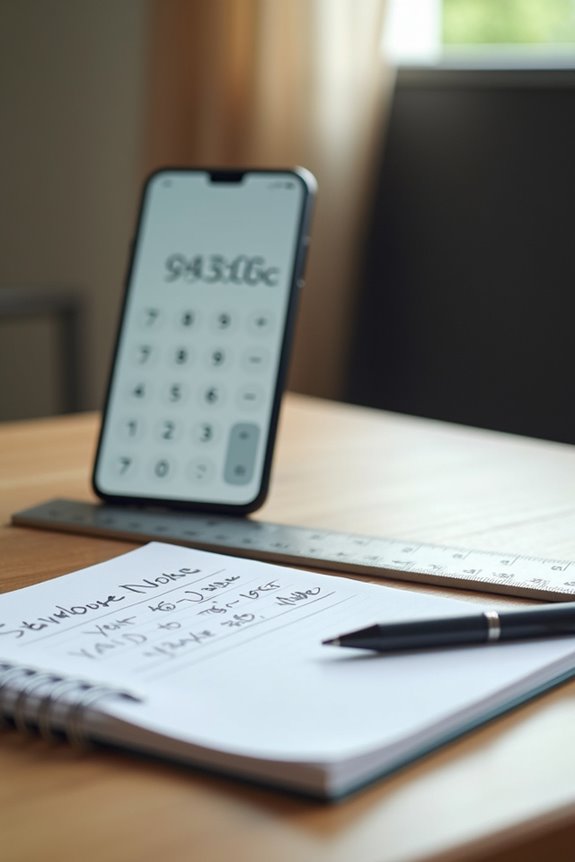
Need to convert yards to meters without breaking out a pencil and paper? A yards-to-meters calculator handles the math instantly using the exact conversion: 1 yard = 0.9144 meters.
How It Works
I input my measurement in yards, and the calculator displays the result in meters automatically. If I need the reverse conversion, it works both ways—enter meters and get yards (roughly 1.09361 yards per meter).
Quick Examples
- 4 yards = 3.6576 meters
- 10 yards = 9.144 meters
- 100 yards = 91.44 meters
The precision settings let me choose decimal places, so results stay consistent with my needs. Just plug in your number and get reliable results instantly.
Why 50 Yards Isn’t 100 Meters (And Other Common Confusions)
Even with a calculator doing the hard work, I’ve noticed people often assume that yards and meters are interchangeable—like they’re just different names for roughly the same distance.
People often assume yards and meters are interchangeable, but they’re fundamentally different units requiring accurate conversion.
Here’s what’s actually happening:
- The conversion factor matters: 1 yard equals 0.9144 meters, not 1-to-1
- 50 yards only equals 45.72 meters, not 100 meters—a significant gap
- Meters are longer: 1 meter is about 1.09361 yards, making meters roughly 9.36% longer
The confusion stems from treating different measurement systems as if they’re equivalent. Yards come from the Imperial system, while meters belong to the SI system. They’re fundamentally different units requiring that conversion factor to translate accurately.
When you’re converting, remember: multiply yards by 0.9144 to get meters. That simple formula prevents the common mistake of assuming 50 yards somehow equals 100 meters.